Conquer the Distance: A 16-Week 100K Ultramarathon Training Plan

Running 100 kilometers isn’t just a feat of endurance — it’s a full-body, full-mind adventure that tests grit, preparation, and trust in the process. Whether it’s your first ultra or you’re leveling up from the 50K distance, this 16-week training plan will guide you to the finish line with structure, smart fueling, intentional recovery, and gear that won’t quit before you do.


Training Plan Overview

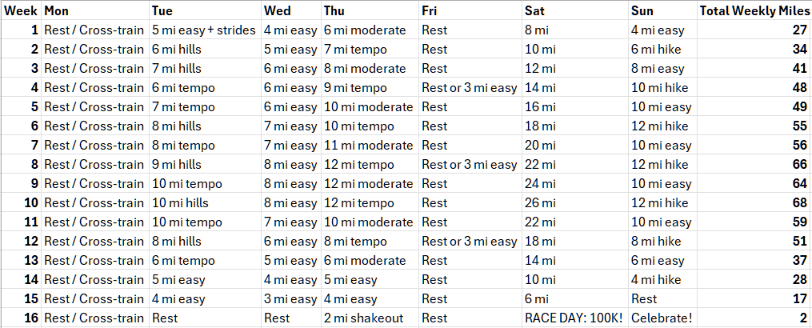
This plan assumes you’re comfortable running 25–30 miles per week and have a solid base. You’ll gradually increase volume and include back-to-back long runs, strength work, and recovery weeks.

Weekly Structure

  • Mon – Rest or cross-train
  • Tue – Speed or hill workout (6–10 miles)
  • Wed – Easy run (5–8 miles)
  • Thu – Medium-long run or tempo (8–12 miles)
  • Fri – Rest or easy shakeout (optional)
  • Sat – Long run
  • Sun – Back-to-back long run or hike

Monthly Focus

  • Weeks 1–4: Base building (30–45 mi/week)
  • Weeks 5–8: Endurance + intensity (40–55 mi/week)
  • Weeks 9–12: Peak mileage (55–65 mi/week)
  • Weeks 13–15: Taper (reduce volume, maintain intensity)
  • Week 16: Race week!

Fueling for the 100K Distance

Fueling isn’t just race-day strategy — it’s a key pillar of training.

During Long Runs and Race Day

  • Carbs: Aim for 200–300 calories/hour (50–75g of carbs)
  • Mix gels, chews, dates, PB&J, boiled potatoes, or sports drink.
  • Practice eating every 30–45 minutes — train your gut!

Pre-Run

  • Eat a carb-rich meal 2–3 hours before long runs: oatmeal, toast with nut butter, or a bagel with banana.

Post-Run Recovery

  • Eat within 30–60 minutes: target carbs + protein (like a smoothie, tofu burrito, or chocolate soy milk and a banana).
  • Hydrate with electrolytes (especially in hot weather).

Recovery Tips to Stay Strong

Training for 100K is as much about rest as it is about running.

  • Sleep 7–9 hours/night — it’s when your body repairs.
  • Foam roll and stretch after runs, especially during peak weeks.
  • Schedule down weeks every 3–4 weeks to reduce mileage by 20–30%.
  • Don’t ignore aches: tight calves and hip flexors today = injury tomorrow.
  • Epsom salt baths, compression socks, and short walks can help sore legs recover faster.

Gear You’ll Want (and Actually Use)

You don’t need a gear closet full of shiny things — but a few quality essentials will make your 100K adventure way more comfortable.

Shoes

  • Trail shoes with solid grip (e.g., Brooks Cascadia, Hoka Speedgoat)
  • Rotate pairs if running high mileage

Hydration Pack

  • At least 2L capacity with pockets for fuel, jacket, and phone
  • Practice with it on long runs

Apparel

  • Technical fabric that won’t chafe
  • Gaiters (optional, but great for dusty/rocky trails)

Extras

  • Headlamp (with backup batteries or charger)
  • Body Glide or Trail Toes (prevent hot spots and blisters)
  • Trekking poles (if your race has big climbs)
  • A watch or app to track distance and elevation

Final Thoughts: Trust the Journey

You’ll have tired legs, early mornings, and runs that go better (or worse) than planned — but each one builds toward that moment when you cross the 100K finish line. Remember:

  • Practice fueling on every long run
  • Listen to your body
  • Recovery is training
  • Gear is your ally, not your distraction
  • Keep showing up

You’ve got 16 weeks. Lace up, plan your long runs, and let the training transform you.


Ready to take the leap? Drop your questions in the comments or tag us in your training photos — we’d love to cheer you on.

Endurance Running as a Journey of Healing from Trauma

When I first laced up my running shoes and hit the trails, it wasn’t about pace, distance, or even fitness. It was about survival. I was searching for a way to quiet the noise—those whispers of doubt, the echoes of pain, and the shadows of experiences I wasn’t sure I’d ever fully outrun. What began as a desperate attempt to escape soon became the very path that led me back to myself.

Running Through the Pain

They say trauma has a way of embedding itself in the body—muscle memory that lingers long after the mind has tried to forget. For me, that tension was palpable: clenched fists, stiff shoulders, a heart that felt too heavy for its own rhythm. Running, at first, was just a means to shake off that weight. I pounded pavement and tore through trails, each step a desperate act of rebellion against everything that had hurt me.

But as the miles grew longer, something shifted. The rhythm of my feet against the earth became a heartbeat, steady and grounding. Breath after breath, I found a cadence that quieted the chaos. It wasn’t escape anymore; it was confrontation. I wasn’t running away from the pain—I was running through it.

The Chaos and the Calm

An abusive relationship is like living in constant turbulence—never knowing when the next storm will hit, bracing for impact, flinching at every raised voice and every heavy silence. The chaos wraps itself around your thoughts, tangling them until even the idea of peace feels foreign. It’s a noise that drowns out everything else—your own voice, your own power, your own worth.

But out on the trails, there is only the sound of my breath, the crunch of gravel, the whisper of wind threading through the trees. It is the first time I remember feeling quiet—not just outside, but within. Step after step, I unraveled the noise. I let it spill out behind me, replaced by the rhythm of my feet and the steady beat of my heart. I didn’t have to brace for impact anymore. I just had to move forward.

The Meditative Miles

There’s a magic in distance running that only those who have chased the horizon can truly understand. It’s the way your mind surrenders somewhere around mile six, slipping into a place that is neither here nor there—just the present moment stretching infinitely. The long miles are like therapy sessions with no time limit, where thoughts are free to roam, resurface, and, finally, rest.

Out there on the trails, with only the wind and the sound of my breath, I learned to confront my thoughts without fear. I faced memories I had buried, emotions I had numbed, and truths I had refused to speak. I also faced the shadows of an abusive relationship—those fractured moments that left invisible scars. Mile after mile, I let the grief surface. I let the tears fall. I let the anger rage. And somehow, I kept moving forward.

Finding Strength in the Struggle

Endurance running taught me that pain is not the enemy. It’s a teacher. Every hill, every cramp, every blister was a reminder that I am stronger than I knew. That my body, despite everything it had endured, could still carry me forward. It could still heal.

I stopped running to forget. I started running to remember—to remember who I was before the trauma, who I wanted to become after it, and the strength it took to keep going when every part of me wanted to stop. Running helped me reclaim my power, step by step, leaving pieces of that past on the trail behind me. Endurance running became my sanctuary, my safe place to unravel and rebuild, one step at a time.

Healing in Motion

I don’t claim that running is a cure for trauma, but it has been my way through. It has been the space where I can feel everything without judgment, where I can confront the hardest parts of my story with the simple act of movement. The trail became my therapist, the miles my medicine. In the silence of those long runs, I found something that had been stolen from me: peace.

If you’ve known pain—real pain—the kind that sticks with you long after the storm has passed, maybe you’ll understand. Maybe you’ve found your own version of healing in the miles, too.

And if you haven’t yet, maybe it’s time to lace up and take that first step. Not away from the pain, but through it.

Prioritizing Mental Health: Finding Balance Through Movement, Nature, Meditation, and Community

May is Mental Health Awareness Month—a time to reflect, reconnect, and rebuild our mental well-being. In the midst of our busy lives, it’s easy to overlook the importance of mental health, but taking time to care for your mind is as crucial as caring for your body. Here are four powerful ways to nurture your mental well-being: through daily movement, grounding in nature, meditation, and community support.

1. Daily Movement: Moving for the Mind

Exercise is not just about building strength or improving physical health—it’s also a powerful tool for enhancing mental health. Whether it’s a brisk walk, a yoga session, or an invigorating run, moving your body releases endorphins, the “feel-good” hormones that help combat stress and anxiety. Studies show that just 30 minutes of movement a day can significantly reduce symptoms of depression and anxiety.

Not sure where to start? Try integrating small bursts of movement into your day: a morning stretch, a lunchtime walk, or a quick evening yoga session. Consistency is key, and the benefits extend far beyond the physical.

2. Grounding in Nature: Find Your Calm in the Great Outdoors

There’s something undeniably healing about being in nature. Grounding—or earthing—is the practice of connecting physically with the earth, whether it’s walking barefoot on grass, hiking through wooded trails, or simply sitting by the water. Studies have shown that spending time in nature can reduce cortisol levels, alleviate stress, and improve overall mood.

If your schedule is packed, even a 10-minute walk in a local park can make a difference. Take your shoes off, feel the grass under your feet, and breathe deeply. Nature has a unique way of bringing us back to the present moment.

3. Meditation: Cultivating Inner Peace

Meditation offers a sanctuary for the mind. In a world that rarely slows down, meditation allows you to pause, breathe, and reset. By focusing on your breath and observing your thoughts without judgment, you can cultivate greater mindfulness and reduce anxiety.

You don’t have to meditate for hours to see the benefits. Start with just five minutes a day. Apps like Headspace or Calm can guide you through simple meditations that fit seamlessly into your routine. Over time, you might find that you’re more grounded, focused, and resilient to stress.

4. Community Support: The Power of Connection

One of the most powerful tools for mental health is connection. Whether it’s talking with friends, joining a community group, or attending a support meeting, sharing your experiences can lighten the emotional load. Community provides a sense of belonging, understanding, and encouragement that is vital for mental wellness.

If you don’t have a close-knit group nearby, consider joining online communities focused on mental health or personal growth. Sometimes, simply knowing you’re not alone can be the strongest form of support. For virtual support options, explore NAMI’s Support Groups or 7 Cups.


Prioritizing Mental Health, One Day at a Time

Mental health is a journey, not a destination. This month, consider incorporating daily movement, time in nature, meditation, and community connection into your life. Small, consistent actions can lead to profound changes over time.

Remember, it’s okay to ask for help. Whether you lean on friends, family, or professional support, prioritizing your mental health is a powerful act of self-care. This May, let’s continue the conversation, break the stigma, and support one another in our journeys to mental wellness.